Large-Format 3D Printing (LSAM): Recyclable Composite Moulds for the Marine Industry
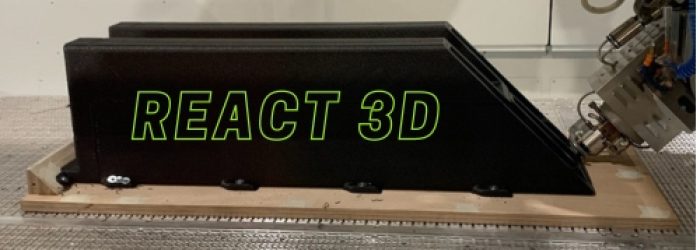
What if a marine mould could be built without a master model, from a recyclable material? That is the goal of REACT 3D (REcyclable Additive Composite Tool 3D), a collaborative project based in Brittany bringing together SMM Composites, Compositic and Elixance.
Its aim: to develop and qualify a recycled and recyclable thermoplastic material for large-format 3D printing, drastically reducing the waste generated by composite mould manufacturing.
A further benefit goes beyond the material balance: by eliminating the epoxy resins and curing agents used to build the mould, 3D printing sharply reduces operators’ exposure to chemical hazards.

Summary
Composite Mould Manufacturing: A Traditional Process That Generates Waste
To understand what large-format 3D printing brings to the table, we first need to look at how a composite mould is built today — and how much material the process consumes.
The conventional method requires two sets of tooling to produce a single mould. A master model is first machined; its surface is then covered with glass fabrics impregnated with thermoset resin to stiffen it and give it its final shape. Only then can the finished carbon mould be laid up on this master model and cured.
Each stage calls on different materials — metal, foam, composite laminates, lay-up consumables — sometimes used for just a few hours before becoming waste. Machining chips, trimming offcuts, contaminated consumables: most of this waste consists of thermoset or mixed materials, which cannot be recycled today.
Lead times add to the problem, as every intermediate tool brings its own manufacturing cycle.
It is this twofold cost — environmental and economic — that the REACT 3D project sets out to eliminate.
Large-Format 3D Printing (LSAM): Printing the Mould Directly, Without a Master Model
Large-format additive manufacturing reverses the logic: instead of removing material around a master model, only the material actually needed is deposited, directly in the shape of the mould.
LSAM (Large Scale Additive Manufacturing) technology consists in extruding a thermoplastic polymer, initially supplied as pellets, through a print head mounted on a robot — either cartesian or articulated. The material is deposited bead by bead to build up the part.
Industrial machines also carry a milling spindle: once printing is complete, the functional surface is machined and then polished to achieve a perfectly smooth finish, ready for composite lay-up.
One key technical point: the polymers used are fibre-reinforced, with two levels of performance. Glass fibre provides the mechanical reinforcement of the printed part. Carbon fibre also improves mechanical properties, but it additionally lowers the coefficient of thermal expansion (CTE) and increases the thermal conductivity of the compound: the mould distorts less and conducts heat better, ensuring its dimensional stability while composite parts are being cured.
To give an order of magnitude, market leader Thermwood quotes extrusion rates of over 200 lbs/h in standard configuration on its LSAM range — around 90 kg/h — and up to 500 lbs/h (roughly 227 kg/h) with its highest-output print heads.
The benefits are immediate: no master model to build, lead times cut down to two steps (print, then machine), and above all a thermoplastic material that is recyclable at end of life. In return, the technology calls for substantial capital investment, higher material costs and genuine plastics-processing expertise: knowledge of thermoplastics, printing strategies and part design. It is precisely this materials expertise that REACT 3D is consolidating.

Which Thermoplastic Materials for a 3D-Printed Mould?
Material selection is the most defining decision of all: it determines the mould’s service temperature, its dimensional stability, its cost and its recyclability.
The entry criterion is the curing temperature of the composite part: the polymer’s HDT (heat deflection temperature) must remain above that of the curing cycle. Next come the CTE, the surface finish after machining and the material cost. Compounds developed specifically for large-format additive manufacturing, reinforced with 20 to 30% carbon or glass fibre, now cover this entire spectrum.
Material data — ABS-CF/GF
| Property | Typical value |
|---|---|
| Matrix / reinforcement | Modified ABS / 20% carbon or glass fibre |
| HDT | ≈ 90–100 °C |
| Strengths | Easy to print, low warpage, controlled cost |
| Applications | Prototyping, master models, low-temperature moulds |
Material data — PC-CF
| Property | Typical value |
|---|---|
| Matrix / reinforcement | Modified polycarbonate / 20% carbon fibre |
| HDT | ≈ 140–145 °C |
| Strengths | High stiffness, excellent surface finish, good cost/performance balance |
| Applications | Marine moulds, thermoforming, medium-temperature tooling |
Material data — PEI-CF
| Property | Typical value |
|---|---|
| Matrix / reinforcement | Polyetherimide / 20% carbon fibre |
| HDT | ≈ 200–212 °C |
| Strengths | Very low CTE, high modulus, inherent flame retardancy, low creep |
| Applications | Aerospace tooling, autoclave moulds, high-temperature applications |
REACT 3D‘s specific contribution focused more precisely on the recycling loop of a PC/CF compound: characterising how properties evolve (fibre length, melt flow, CTE) across successive cycles, and defining strategies for reincorporating recycled material into virgin resin, in order to reconcile mould performance with a favourable life-cycle assessment.
From Marine to Aerospace and Shipbuilding
The know-how developed on marine moulds transfers directly to any sector that relies on large-scale composite tooling.
In aerospace and defence, tooling printed in carbon-filled PEI or PESU withstands autoclave cycles and answers a strategic need: producing moulds locally, in a matter of days rather than months, with a sovereign supply chain.
In shipbuilding, the technology has already proven its ability to produce massive parts — hulls several metres long have been printed in a single operation (source).
For a manufacturer, the equation is straightforward: tooling lead times cut sharply, production waste reduced to recyclable chips, and a controlled carbon footprint across the entire life cycle.
Have a composite mould or tooling project in mind? Let’s talk materials: our team will help you select the compound best suited to your application.
Discover our collaborative projects